Caltech and Corporate Partnerships in Electricity Transmission
Exhibit Summary
This exhibit examines Caltech’s partnerships with the corporate world in developing electricity transmission to Los Angeles. It focused on the start of Caltech’s work on the transmission problem via the work of Professor Royal W. Sorensen, who founded Catech’s Electrical Engineering department in 1910 (Fox et al., 14). The exhibit traces Sorensen’s work on Eagle Rock and Kern substations as a consulting engineer for Pacific Light & Power, then examines the more large-scale collaboration of Caltech personnel with Southern California Edison in the construction of the High Voltage Laboratory and the subsequent research at the facility.
This exhibit demonstrates the strong and mutually beneficial partnership between Caltech and power companies and shows the important role of Caltech’s expertise in upgrading high voltage transmission lines and powering Los Angeles.
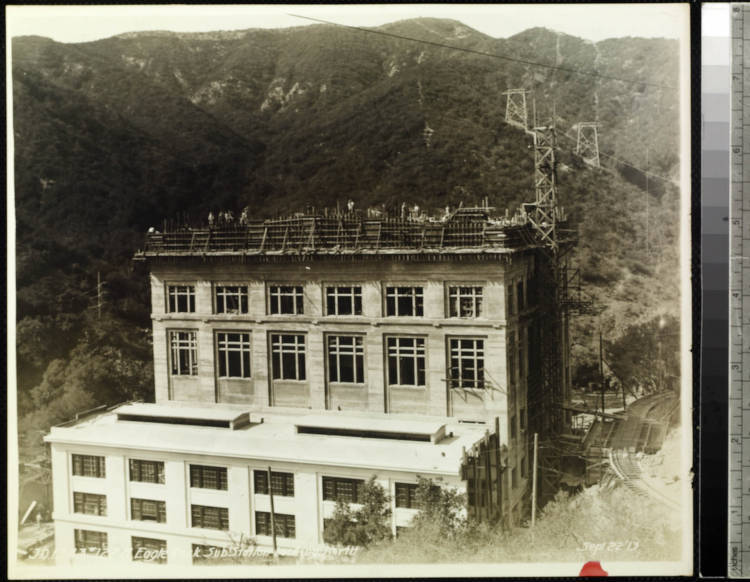
The Eagle Rock Substation was the endpoint of the transmission lines stretching from the Big Creek to Los Angeles, initially spanning 240 miles and operating at 150,000 volts (Cox and Michener, 1). Construction started in February 1913, and this photo was taken in August 1913, when construction was partially complete. The transmission lines became fully operational in December 1913, supplying Los Angeles with 60,000 kilowatts of electricity, or 20% of the city’s electricity (Fredericks, 350). Though 85% electricity went to running Pacific Light & Power’s (PL&P) street railroads, the rest was sold to business and residents (Friedricks, 351).
As early as the 1910s, Caltech was already involved in the issue of electricity transmission to Los Angeles, via Professor Royal W. Sorensen, who served as a Consulting Engineer for PL&P from 1913 to 1917 (“Orange and White”). Part of his work as Consulting Engineer involved conducting experiments on PL&P infrastructure, such as the resistance of water jets at Eagle Rock (Royal W. Sorensen).
Sorensen’s connection to Eagle Rock extended beyond his official role as Consulting Engineer. In April 1920, Sorensen led a field trip of senior Electrical Engineering students to the substation (“Orange and White”). As reported in the Orange and White book of 1919-1920 (Caltech’s student yearbook at the time), “Mr. Sorensen had done considerable work in the station and on the Big Creek transmission and was therefore able to accurately explain many details of the equipment,” further verifying Sorensen’s extensive work on transmission (“Orange and White”).
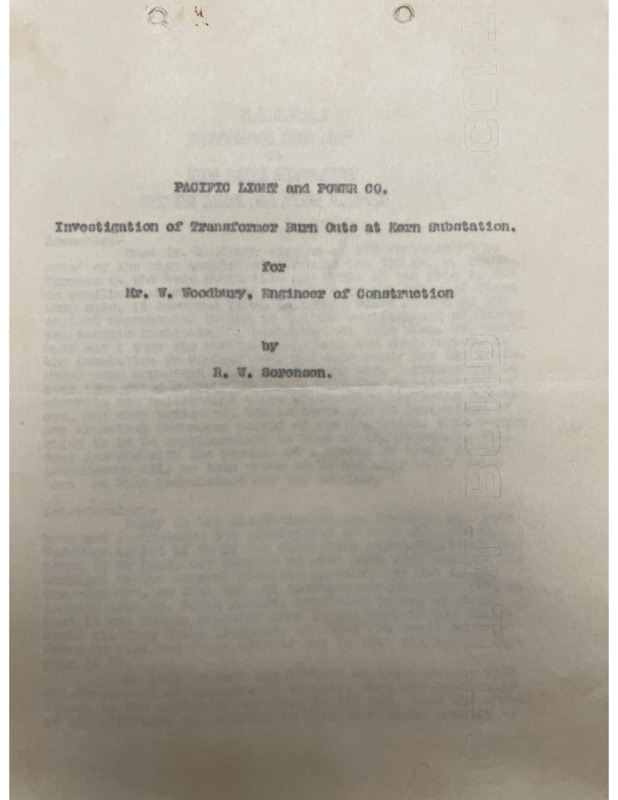
This report describes Professor Sorensen’s experiments on the Kern substation, owned by Pacific Light and Power (PL&P). Sorensen was a Consulting Engineer for PL&P from 1913 to 1917, where he performed troubleshooting experiments at PL&P facilities (“Orange and White”). In 1913, Sorensen was asked to fix the transformer burn outs at Kern substation. Sorensen hypothesized that the cause was the contamination of the oil in the transformer.
He based this hypothesis on previous lab experience. As he states in the report, in 1907, he dealt with “transformer trouble” caused by the “notion of sulphur in the oil.” To test this hypothesis, Sorensen chemically confirmed the presence of sulfur. Sorensen also saw this experiment as an opportunity to apply Caltech’s oscillograph (or oscilloscope, in today’s terms) to confirm that no other factors were causing the burn outs.
This report demonstrates the importance of Caltech’s technical expertise and equipment to LA’s electrical infrastructure. Without Sorensen’s previous experience, it would have been difficult for PL&P’s engineers to immediately identify the issue. Sorensen’s particular contribution to commercial power transmission was acknowledged in Caltech’s 1920 yearbook, where students credited him with having “designed and installed all the large electrical machinery in California” (“Orange and White”).
The impact of Caltech’s EE department as a whole was confirmed by an oral interview in 1978 with Professor William Pickering, a former professor in Electrical Engineering, who stated that the department “had done some very useful work in helping the Edison Company develop the first long-distance transmission lines” from Fresno down to Los Angeles (William Hayward). In Pickering’s words, it was this initial work that eventually helped Sorensen and Caltech obtain Edison’s support in building the High Voltage Laboratory (William Hayward).
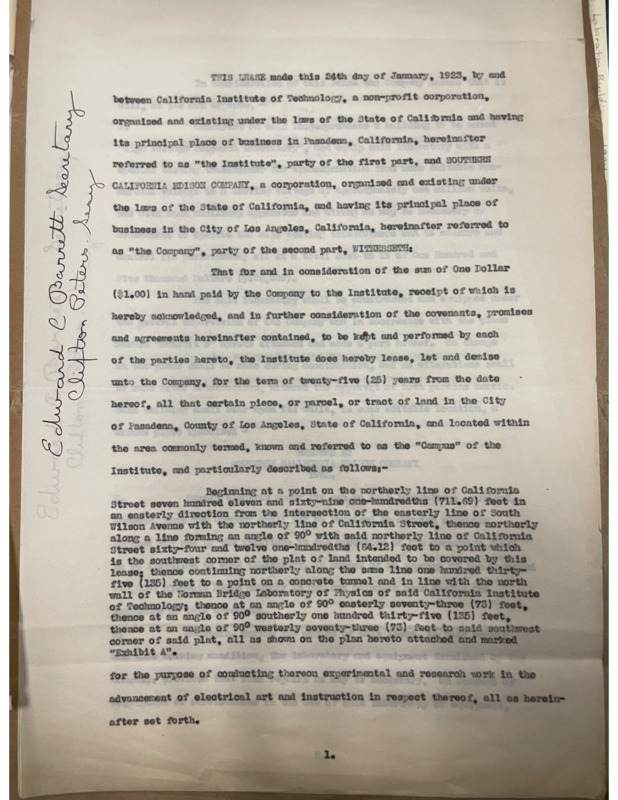
This lease contract between SCE and Caltech describes the terms for the High Voltage Lab, which marks the most direct collaboration between Caltech and industry since Caltech’s founding. SCE provided $105,000 to build the million volt transformer, while Caltech provided $34,915 to cover additional costs (D. M. Trott).
SCE funded the High Voltage Lab so that they could complete the technical research needed to raise transmission to 220,000 volts (J. L. Heilbron and Robert W. Seidel). The lease states that Caltech “will make available to the Company…the advice and learning of the staff of the Institute” (Southern California Edison and Caltech). As a result, Caltech personnel often helped SCE personnel (Frederick Lindvall).
The lease also dictates that research produced at High Volts and profit from patents were “the property jointly” of Caltech and SCE (Edison and Caltech). For example, when Sorensen and Millikan patented their vacuum switch, the patent was jointly sold by Caltech and Edison to General Electric for $100,000 in 1930, which almost repaid the cost of the lab (Heilbron and Seidel). Though the lease guaranteed SCE 25 years in the laboratory, their involvement decreased as they completed their research (Edison and Caltech, Lindvall). Caltech continued to use High Volts for physics research until it was renovated in 1960, solidifying a successful chapter of Caltech’s collaboration with industry.
Word Count: 197 words
Sources: